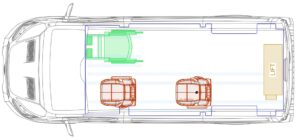
A wheelchair-accessible minibus is a minibus that has been converted so passengers can board and travel while remaining seated in their wheelchair. In practice, this usually means three changes to the vehicle: a powered lift to help people board, tracks in the floor to secure each wheelchair, and seats that can be moved or taken out to make room.
Schools, care providers, community transport groups, health trusts and charities all use them. What they have in common is the need to move a group of people, some of whom use wheelchairs, safely and without anyone having to transfer out of their chairs.
This guide explains how the conversion works, what the main features do, the layout choices you’ll come across, and what’s worth working out before you look at wheelchair accessible minibuses for sale.
How Is It Different From A Standard Minibus?
A standard minibus is built around fixed seats. Passengers climb in using a step and remain in the same forward-facing seat for the whole journey. That works well until one of your passengers uses a wheelchair and can’t transfer out of it.
An accessible minibus often starts with the same base vehicle. The conversion then changes how people get on, how the floor is laid out and how wheelchairs are held in place once they’re inside. Here’s how the standard specification compares across TBC’s standard minibuses and accessible minibuses:
| Standard minibus | Accessible minibus | |
| Seating | Fixed seating | Quick-release seating that can be moved or removed |
| Getting on board | Electrically operated step | Electrically operated step plus an inboard passenger lift |
| Lift options | Not applicable | Underfloor lift available as an option |
| Moving around inside | Upper cantrail not listed as standard | Full-length upper cantrail (grab rail) |
| Rear-view camera | Included | Included |
Both can be specified with extras such as climate control, CCTV, front and rear parking sensors, luggage racks, low-level lighting, an easy-clean finish, and vehicle graphics.
The Main Features Of A Wheelchair Accessible Minibus
Passenger Lift
A minibus floor sits too high for a ramp to be practical in most cases. The slope would be long and steep, which is why ramps are more common on smaller wheelchair-accessible vehicles with lowered floors. On a minibus, a powered lift does the job instead: the platform lowers to the ground, the passenger moves on, and the lift raises them to floor level.
There are two main types:
- Inboard lift, which folds up inside the vehicle, just behind the door, when it isn’t in use. This is standard on TBC’s accessible minibuses.
- Underfloor lift, which stows in a cassette beneath the floor, leaving the doorway clear. TBC offers this as an option.
Which suits you depends on how often the lift will be used and whether other passengers need to use the same doorway. Whichever you choose, check the lift’s safe working load against the heaviest wheelchair and passenger you expect to carry. Powered wheelchairs can weigh far more than manual ones.
Floor Tracking and Wheelchair Restraints
Once inside, each wheelchair is secured to rails set into the floor, known as tracking. The usual set-up is a four-point tie-down: two straps at the front of the chair and two at the back, all anchored to the tracking.
The passenger then fastens their own lap and diagonal seatbelts, which are separate from the straps securing the chair. One stops the wheelchair from moving; the other protects the person sitting in it. Both are needed on every journey.
Wheelchair users normally travel facing forwards. It’s also worth checking that each passenger’s wheelchair is suitable for use as a vehicle seat, as not every model is. The wheelchair manufacturer or the passenger’s occupational therapist can usually confirm this.
Quick-Release Seating
Quick-release seats sit on the same floor track as the wheelchair restraints. They can be unlocked, repositioned or removed altogether, so the same vehicle can carry more seated passengers one day and more wheelchair users the next.
This flexibility is one of the main reasons organisations choose an accessible minibus over a fixed layout. It helps if more than one person in your team knows how to change the configuration, so the vehicle isn’t stuck in a single layout when a regular driver is off.
Steps, Rails and Lighting
Not everyone on an accessible minibus uses a wheelchair. Many passengers walk on but may be unsteady, use a walking aid, or need a lower first step. TBC’s accessible minibuses include an electrically operated step (a manual step is available as an option) and a full-length upper cantrail, a grab rail running along the ceiling that passengers can hold while they find their seat. Optional low-level lighting makes the floor and step easier to see in the dark or in poor light.
Front Entry or Side Entry?
TBC builds accessible minibuses in two layouts, named after where the main passenger door is located. Neither is better across the board. The right one depends on where your passengers get on and off.
- An accessible front entry minibus suits organisations with supervised or fixed boarding points, such as a school, day centre or care setting, where staff help passengers on at the same place each day. It’s currently listed in 9 and 17-seat versions.
- An accessible side entry minibus suits kerbside and multi-stop operations, such as community transport routes with regular pick-ups outside homes or community venues. It’s currently available in 9 and 16-seat versions.
The specification is the same on both, including quick-release seating, the inboard lift and the upper cantrail. What changes is how the vehicle operates at the kerb.
Who Uses Wheelchair Accessible Minibuses?
Most accessible minibuses are bought by organisations rather than individuals, including:
- Community transport operators providing door-to-door services and group trips for people who can’t easily use public transport
- Health and social care trusts, moving service users between home, day services and appointments
- Schools, for daily transport, trips and activities
- Care homes and day centres, for outings and appointments
- Charities, clubs and community groups that run their own transport
Several of these organisations have shared their experiences of working with TBC on our customer testimonials page, including community transport groups that have purchased accessible vehicles from us over many years.
Is an Accessible Minibus the Same as a WAV?
Strictly speaking, an accessible minibus is a type of wheelchair-accessible vehicle. In everyday use, though, “WAV” usually refers to a smaller vehicle for an individual or family, often leased through the Motability Scheme.
If you’re a family needing space for a wheelchair and several passengers, a large WAV may suit you better than a minibus. The Mercedes-Benz Sprinter WAV, for example, seats six plus a wheelchair user and is available through the Motability Scheme or privately. You can compare sizes and layouts across our full WAV range.
Buying a Wheelchair Accessible Minibus: What to Work Out First
A few answers make the conversation about specifications much quicker, whether you’re buying one vehicle or adding to a fleet.
- How many wheelchair users travel at once, and how many seated passengers? Plan for your busiest regular journey, not the average one. Quick-release seating gives you room to adjust, but the vehicle size sets the limit.
- What wheelchairs do your passengers use? Size and weight both matter. A large powered chair affects the lift capacity you need and the space it takes up on the floor.
- Where will passengers get on and off? Fixed, supervised pick-up points and busy kerbside stops can point you towards different layouts.
- Who will drive it? The licence required to drive a minibus depends on the driver’s licence, when they passed their test, the vehicle’s weight, the number of passenger seats, and whether passengers pay to travel. Check the latest DVLA guidance on driving a minibus before you settle on a vehicle size, as it can affect which of your drivers can use it.
- Do you need a vehicle quickly? A new conversion is built to your specification. If timing matters, our stock accessible vehicles include Mercedes Sprinter 16-seat and 17-seat accessible minibuses, alongside the Ford E-Transit 9-seat accessible MPV, subject to availability.
- What support comes after delivery? TBC’s minibuses come with a three-year warranty as standard, with an optional five-year conversion warranty available at an additional cost. Minibus customers can also arrange a tailored aftersales package and have a dedicated aftersales contact.
Talk Through Your Requirements With Our Minibus Team
The best starting point is usually a conversation about your passengers, routes and drivers, rather than a spec sheet. TBC minibus customers work with a dedicated account manager who can talk you through the layouts, lift options and seat configurations that suit how your organisation actually runs.
Explore our wheelchair accessible minibus range, or get in touch with the minibus team to discuss passenger numbers, accessibility and the vehicles currently available.